
Happy New Year, everyone! Thank you for being a part of our community and arming yourselves with knowledge to stay ahead.
This week, we’re kicking off the new year with a mix of fascinating and crucial topics. From the first meteor shower of 2026 to historic missions exploring Mars and Venus, we’ve got a lot to explore. We’ll also dive into the importance of America’s leadership in science, share some personal resolutions for a sharper mind and body, and provide crucial winter weather safety tips that’ll help you get through the cold and slippery months ahead.
Plus, don’t forget to read the latest installment of the Tornado Quest Chronicles, check your NOAA weather radio, and prepare for winter weather. In the northern hemisphere, winter is just getting ramped up.
So, grab a cup of coffee, settle in, and let’s dive into the first days of 2026 and the fascinating world of science, weather, and climate together!
- A personal resolution for the new year, read more than I already do, which is a lot. Reading for fun slashes stress, boosts creativity, and builds empathy yet only 16% of Americans still do it; why not join us and rediscover the joy of books in 2026?
- Speaking of resolutions, make 2026 your year for a sharper mind: better sleep, regular movement, and deep breathing can help your brain clear out daily clutter and stay healthier as you age.
- America’s historic leadership in science, driving breakthroughs from life saving medicines to world changing technologies, has been the backbone of its prosperity and security, but recent deep cuts to research funding now risk crippling that legacy, threatening both future innovations and the nation’s global standing.
- The Quadrantids, the first meteor shower of 2026, peak overnight January 3–4 with bright fireballs, best seen in the Northern Hemisphere’s predawn hours, though a full moon may make them harder to spot.
- 2026 will be a historic year in space: new missions explore Mars and Venus, telescopes unlock cosmic mysteries, and reusable rockets make space travel more accessible than ever.
- The winter solstice, the shortest, darkest day of the year, marks the moment when daylight begins to slowly return, promising brighter days ahead.
- Wildfire smoke, intensified by climate change, now threatens U.S. public health on a massive scale, causing tens of thousands of premature deaths annually.
- 2025 shattered heat records in Central Asia, the Sahel, and parts of Europe, with some regions experiencing temperatures up to 3°C above average, while global data confirmed it as the third-hottest year ever recorded.
WHEN SNOW MEETS SCIENCE: WHAT EVERY NON-METEOROLOGIST NEEDS TO KNOW

WINTER WEATHER PREPAREDNESS
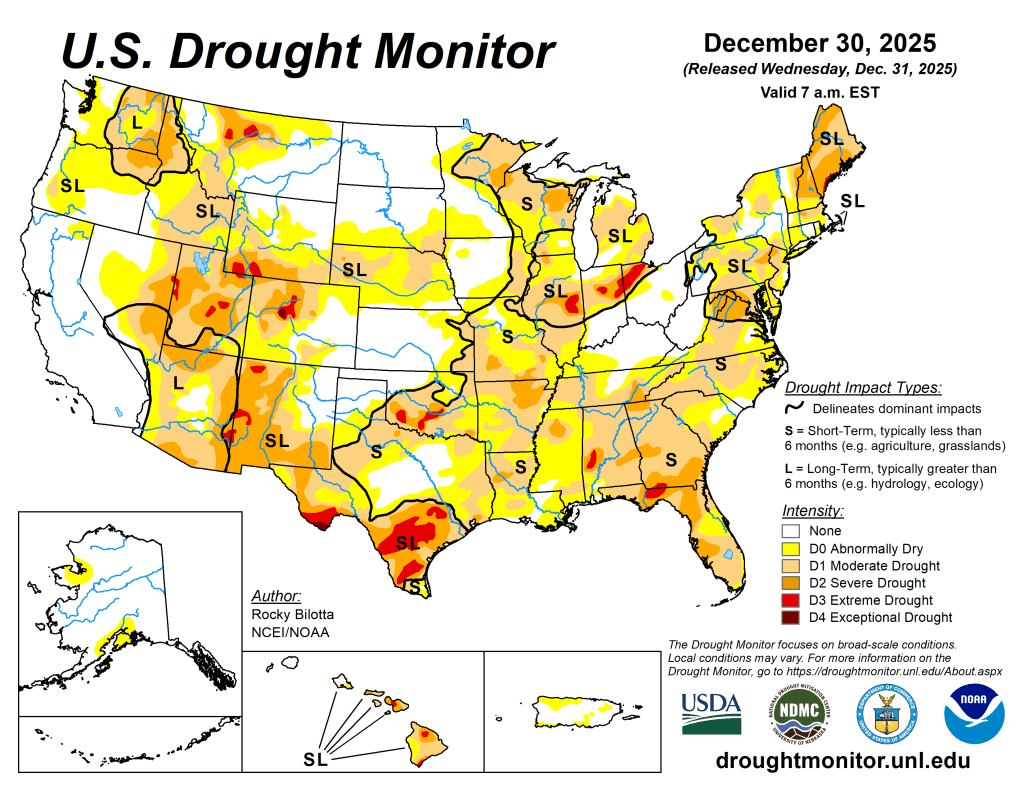
US DROUGHT MONITOR
Here’s this week’s US Drought Monitor. This week, the U.S. experienced a dramatic weather rollercoaster: a “heat dome” brought record breaking warmth to the central and southern states, making Christmas Day the hottest on record, only for a powerful winter storm to sweep in days later, plunging temperatures from summer like highs to near freezing and dumping heavy snow and ice across the Midwest and Northeast, while California faced torrential rain and mountain snow from a strong storm system.. The latest fire weather outlooks can be found at the Storm Prediction Center website where they are updated daily.
NOAA WEATHER RADIO
Here’s your weekly reminder to check your NOAA weather radio’s operation and its batteries. NOAA has a comprehensive page on NOAA weather radio…a feature of the National weather Service in the USA that has saved countless lives.

CITIZEN SCIENCE
Citizen science lets everyday people actively shape real research by sharing observations and data. Join now to make a tangible impact, discover new insights, and become part of a global community driving scientific breakthroughs!
- The CoCoRaHS project invites weather enthusiasts to become citizen scientists by submitting daily precipitation reports that support forecasting and climate research even on dry days.
- Another path into becoming a citizen scientist is using the free mPING app! Your weather reports go directly to the National Severe Storms Laboratory in Norman, OK!
That’s a wrap for this week! Thanks for stopping by! See you next Saturday!
™ Tornado Quest © 1998‑2026 Tornado Quest, LLC. All Rights Reserved.
 TORNADO QUEST
You must be logged in to post a comment.