Greetings everyone. While it’s quiet, now’s the time to prepare. Check out the Severe Weather Preparedness And Tornado Safety page for a wealth of very important information. Be sure to read the latest installment of the Tornado Quest Chronicles for a look back at an unusual winter. I’ve curated several thought-provoking articles for this week to keep you informed and inspired. Settle in for some good reads, brush up on your severe weather and tornado safety information, and keep that hunger for knowledge going strong.
- On April 1, 2026, NASA’s Artemis II mission launched four astronauts on a historic 10-day journey around the moon, the first human lunar voyage in over half a century, testing critical systems for future lunar landings while marking the first time a woman and person of color will travel beyond low Earth orbit.
- Scientists have discovered that about one-fifth of the world’s open oceans are becoming darker and less able to let sunlight penetrate, a mysterious shift linked to climate change and human activity that could disrupt the daily rhythms of countless marine creatures.
- Despite containing valuable metals and toxic chemicals, only about 22% of the world’s electronic waste is properly recycled, but experts urge consumers to use manufacturer take-back programs or certified drop-offs to recover resources and prevent environmental harm.
- Warming winters are forcing American cities to spend tens of thousands of dollars daily filtering dangerous chemicals from drinking water. This is a cost that raises your water bill and poses real health risks to families relying on private wells.
- A recent study reveals that our intuition often misleads us, causing us to overvalue visible but minor efforts like recycling while significantly underestimating the massive climate impact of other everyday high-carbon activities.
- Even if you question climate change, the fact that Alaska’s frozen ground is now releasing trillions of gallons of extra water and ancient carbon annually is a concrete, accelerating reality that directly threatens local ecosystems and global stability.
- Authoritarian censorship has silenced ‘climate’ in federal labs. This is forcing scientists to rewrite reality itself just to keep their research alive.
- This winter (2025-2026) broke every record in the western USA. Scientists say what comes next could be unlike anything we’ve seen before.
SEVERE WEATHER AND TORNADO SAFETY AND PREPAREDNESS
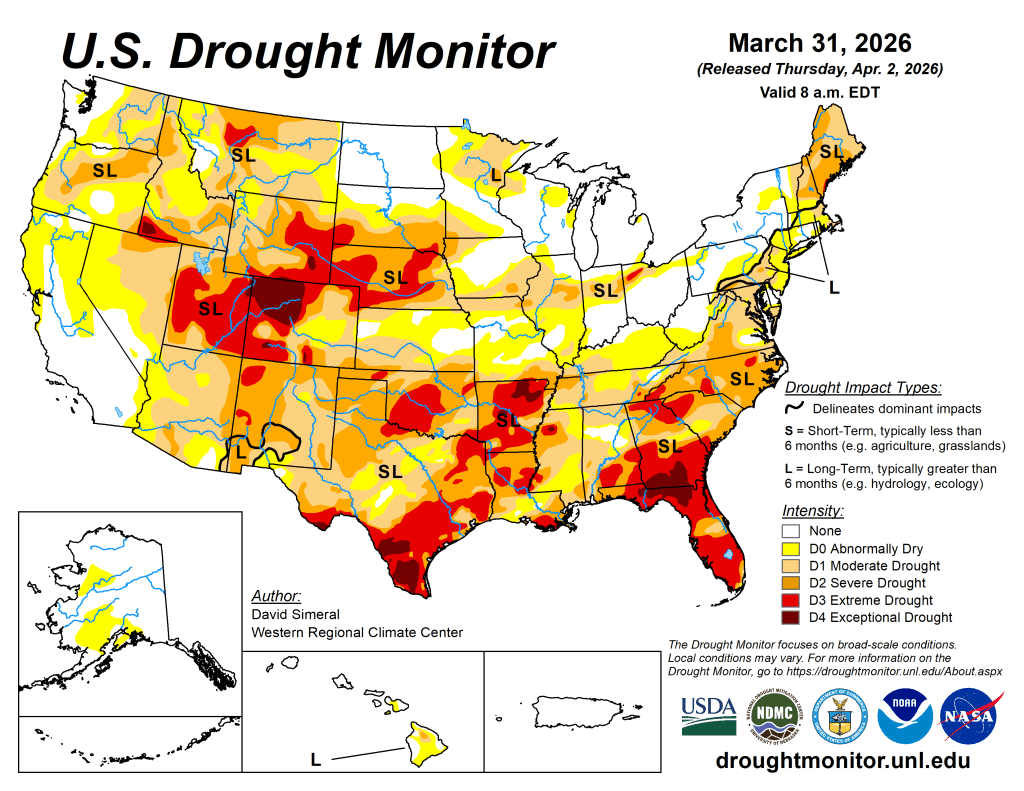
US DROUGHT MONITOR
The U.S. is currently facing significant drought challenges, particularly across the West, Plains, South, and Southeast regions. Mountain snow pack, the natural water storage that feeds rivers and reservoirs, is at record-low levels, with California’s snow pack at just 18% of normal. While some major reservoirs like Lake Shasta and Lake Oroville are still holding adequate water, others like Lake Powell and Lake Mead are critically low at roughly one-quarter to one-third capacity. The good news is that the next week should bring relief to many areas, with 2 to 4 inches of rain expected across the Southern Plains, Midwest, and Northeast, though the Southwest will likely stay dry. Temperatures are forecast to run warmer than usual across the western and southern states, which could worsen drought conditions there, while the northern Plains may see cooler weather. Overall, the situation remains concerning for water-dependent regions, but upcoming rainfall offers some hope for improvement in several areas.
NOAA’s US Drought Monitor website has the full regional details. The latest daily fire weather outlooks can be found at the Storm Prediction Center website.
NOAA WEATHER RADIO
Here’s your weekly reminder to check your NOAA weather radio’s batteries, programming, settings, and reception. NOAA has a comprehensive page on NOAA weather radio…a feature of the National weather Service in the USA that has saved countless lives.

CITIZEN SCIENCE
Citizen science lets everyday people actively shape real research by sharing observations and data. Join now to make a tangible impact, discover new insights, and become part of a global community driving scientific breakthroughs!
- The CoCoRaHS project invites weather enthusiasts to become citizen scientists by submitting daily precipitation reports that support forecasting and climate research even on dry days.
- Another path into becoming a citizen scientist is using the free mPING app! Your weather reports go directly to the National Severe Storms Laboratory in Norman, Oklahoma!
That’s a wrap for this week! Thanks for stopping by! See you next Saturday!
™ Tornado Quest © 1998‑2026 Tornado Quest, LLC. All Rights Reserved.


You must be logged in to post a comment.