
In spite of a quiet Atlantic, hurricane season is here and this week NOAA maintains its below normal forecast for the 2026 Atlantic hurricane season. As the director of the National Weather Service has already said this year, it only takes one. The Hurricane Safety page on Tornado Quest has everything you need to prepare before you need it. Heat Safety information is on the Invisible Storm page. Citizen Science links are included in this week’s post along with your weekly reminder to check your NOAA weather radio. The updated US Drought Monitor is here as well. I’ve got ten good reads this week ranging from the hottest month ever recorded in the contiguous United States to prenatal wildfire smoke health threats confirmed in peer reviewed research, to the sharpest solar surface images ever captured and the largest known galaxy at 1.7 million light years wide. Settle in, there’s plenty to enjoy.
- The largest known galaxy stretches an astonishing 1.7 million light years wide. Here’s how it got so big.
- Scientists captured the sharpest ever images of the sun’s surface. They reveal swirling plasma patterns that could help us better predict how solar storms affecting Earth and your everyday life.
- What happens when the people who enforce environmental law become the ones challenging it? The powers that be decide which laws matter and which companies get to keep breaking them.
- We may not yet know how dangerous microplastics truly are, but the thousands of proven endocrine-disrupting chemicals in your kitchen plastics already should make you swap them out.
- There’s a new kind of heat wave melting America snowpack at an alarming rate. Here’s what that means for the western USA.
- Spokane, Washington’s wildfire crisis reveals a terrifying new normal. What does it mean for the rest of us?
- Decades of regulatory triumphs cleaned the air for generations, but as the climate burns hotter, the smoke rolling over our babies suggests we may have won the battle only to lose the war on our own terms.
- Are long range weather forecasts going out weeks or months possible? There is a limit.
- July 2026 set a record for the contiguous USA that unfortunately, is going to be broken again far too soon.
- In case you missed it last week, NOAA still predicts a below normal 2026 Atlantic hurricane season, but with El Niño strengthening and the peak of season approaching, now is the time to prepare. It only takes ONE storm!
HURRICANE AND TROPICAL CYCLONE SAFETY AND PREPAREDNESS
THE INVISIBLE STORM
NOAA WEATHER RADIO
Here’s your weekly reminder to check your NOAA weather radio’s batteries, programming, settings, and reception. NOAA has a comprehensive page on NOAA weather radio…a feature of the National weather Service in the USA that has saved countless lives.

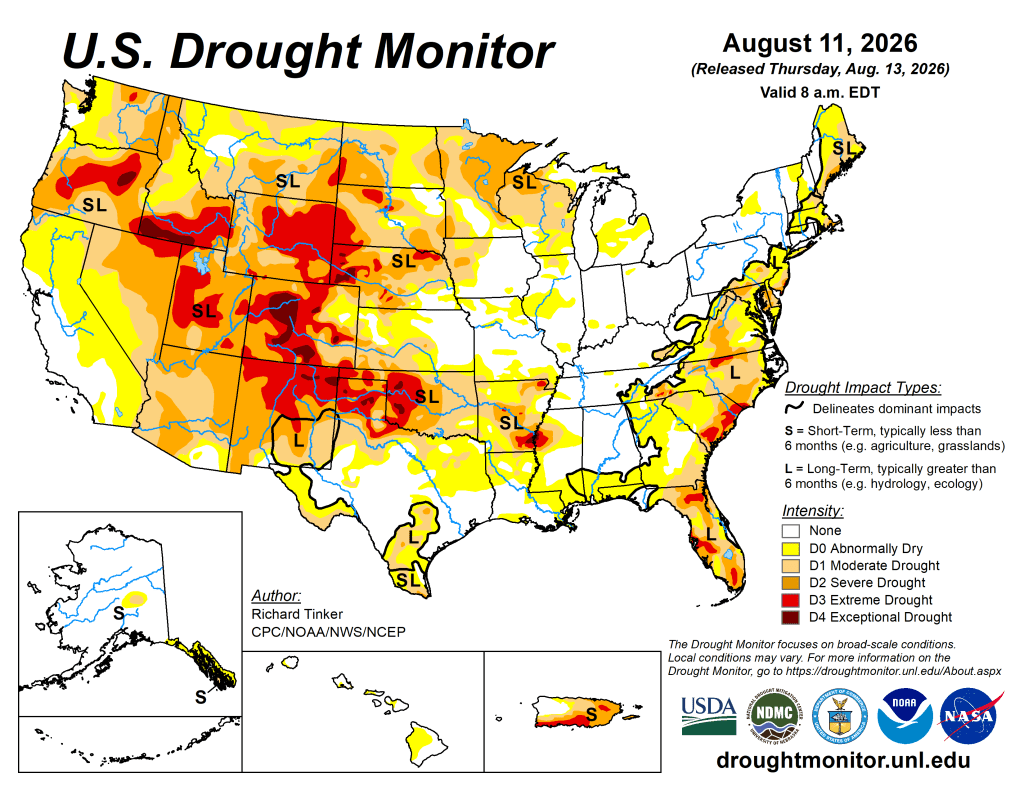
US DROUGHT MONITOR
This past week brought a mix of heavy rain and dry spells across the U.S., with some areas in the Midwest, Ohio Valley, and Southeast seeing up to 7 inches of rainfall, while much of the West, Great Plains, and Great Lakes stayed dry. Looking ahead, moderate to heavy rain is expected in parts of the central and northern Plains, Rockies, and East Coast, while temperatures will likely stay well above normal in the Southern Plains and the Southeast. Cooler conditions are forecast for the North and West, with most of the country trending toward much warmer and slightly wetter weather in the coming days. In spite of rainfall potential, many areas are at the peak of their annual average high temperatures for the year. See The Invisible Storm for heat safety information.
- NOAA’s US Drought Monitor website has the full regional and state details.
- The latest daily fire weather outlooks can be found at the Storm Prediction Center’s website.
CITIZEN SCIENCE
Citizen science lets everyday people actively shape real research by sharing observations and data. Join now to make a tangible impact, discover new insights, and become part of a global community driving scientific breakthroughs!
- The CoCoRaHS project invites weather enthusiasts to become citizen scientists by submitting daily precipitation reports that support forecasting and climate research even on dry days.
- Another path into becoming a citizen scientist is using the free mPING app! Your weather reports go directly to the National Severe Storms Laboratory in Norman, Oklahoma!
That’s a wrap for this week! Thanks for stopping by! See you next Saturday!
™ Tornado Quest © 1998‑2026 Tornado Quest, LLC. All Rights Reserved.


You must be logged in to post a comment.